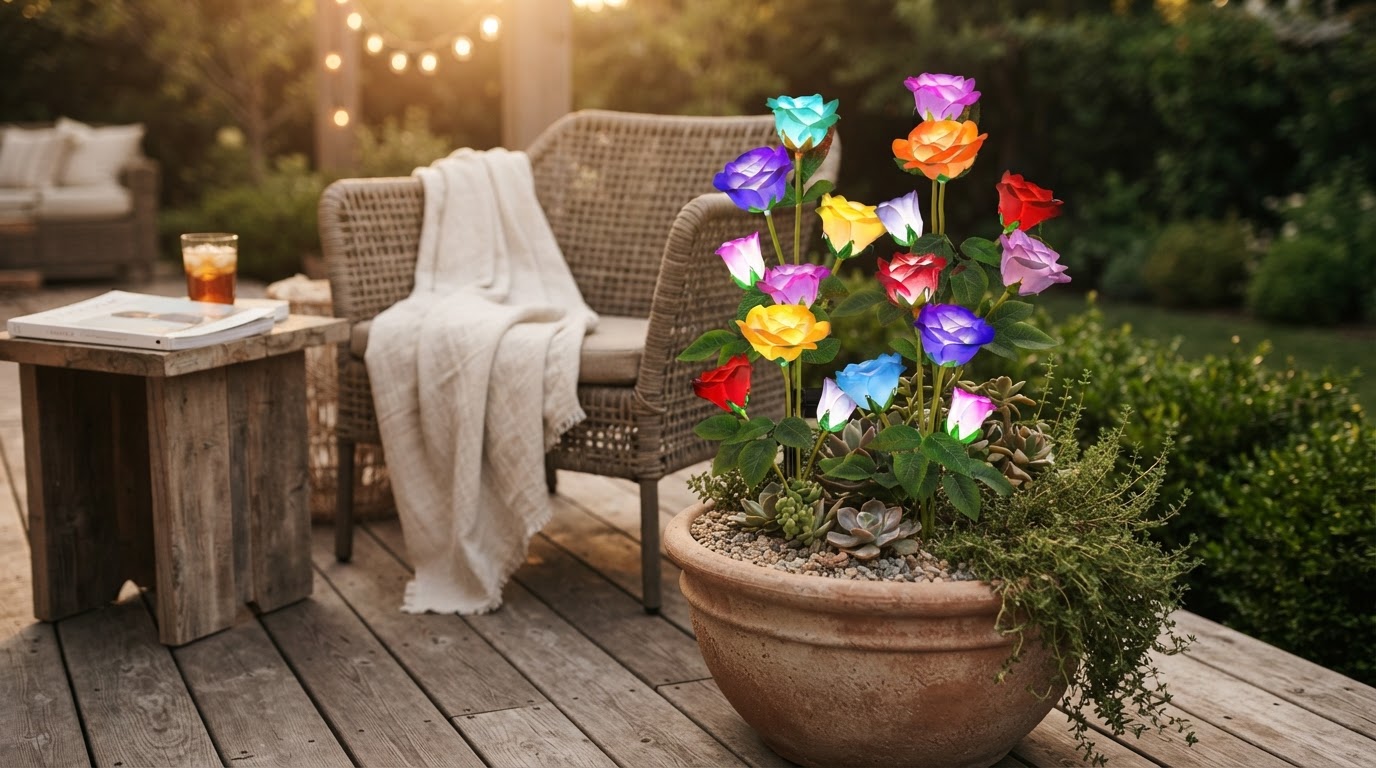
How do color changing solar Glow Roses work?
 Sam VasquezBuying Guide Lead
August 31, 2026 — Color changing solar Glow Roses function by utilizing a pulse-width modulation (PWM) controller to cycle through red, green, and blue LED filaments powered by a stored battery charge.
Homeowners often ask this because they want to know if these transitions are mechanical or digital, and how long the effect lasts after a full day of sun. Understanding the internal circuitry helps in selecting the right placement for consistent performance and long-term durability.
How does the internal circuitry manage color shifts?
Color shifting in solar Glow Roses is managed by an integrated circuit (IC) that regulates the voltage sent to a multi-die RGB LED. Unlike standard white LEDs, these units contain three distinct chips in one housing. The IC gradually increases and decreases current to each chip, blending colors to create intermediate shades like purple and yellow. According to LEDVANCE, these garden solar lights are increasingly equipped with intelligent functions such as color-changing dimming and sensing. In my experience, the smoothness of this transition depends heavily on the quality of the controller; cheaper models might flicker, while solar Glow Roses aim for a fluid gradient. that the internal photoresistor acts as the gatekeeper, ensuring this process only begins when ambient light levels drop below a specific threshold, usually measured in lux.
Why do different solar lights have different color modes?

Different solar lights offer varying modes because of the specific microcontroller programmed during manufacturing. Some units, like the Solar Pathway Lights from SMY Lighting, are designed to auto-change specifically between red, green, blue, yellow, pink, and purple. Between these two, I’d go with a model that allows for a 'lock' function if you prefer a static color, but many decorative rose lights are hard-wired for a continuous cycle to mimic a natural, shifting garden aesthetic. The efficiency of these modes is tied directly to the battery capacity; driving multiple LED dies simultaneously consumes more power than a single white LED. If you're on a budget, you might see fewer color variations or a faster cycle that drains the battery by midnight. For those prioritizing duration, checking the milliamp-hour (mAh) rating of the internal Ni-MH battery is essential to ensure the color-changing cycle lasts the full night.
Quick answers

Photo by Jeffry Surianto on Pexels
Q: Do I need to manually turn on the color changing feature? A: Most models require you to unscrew the light cap and flip a physical switch to 'ON' or 'RGB' before the first use, as noted by SMY Lighting. Once active, the light uses an internal sensor to trigger the color cycle automatically at dusk.
Q: How many colors do solar Glow Roses typically display? A: These units generally cycle through 7 distinct primary and secondary colors by blending red, green, and blue light. The transition creates hundreds of micro-shades during the shifting process.
Q: Does the color changing mode drain the battery faster than white light? A: Yes, because the system often powers multiple LED filaments to create blended colors, it can draw slightly more current. However, solar Glow Roses are engineered with high-efficiency 600mAh to 800mAh batteries to offset this demand.
Internal links for further reading include the waterproof outdoor solar light buying guide and my tips on [how to maintain solar garden lights](/blog/how-to-maintain-solar-glow-roses) for peak brightness. If you are looking for specific product recommendations, see the list of the best color changing solar rose lights.
Skip this if you only want static, warm-white illumination, as the cycling effect cannot be disabled on all decorative models. Here’s what I’d actually buy: a unit with a monocrystalline silicon panel for the fastest charging times in shaded areas.
Learn more about solar Glow Roses at https://solyraglowroses.com. External source: SMY Lighting.